Some links on this page are affiliate links. If you buy through them I may earn a small commission at no extra cost to you.
In this story
We asked for two tomatoes. Not 2 kilograms — two, because we wanted to know what an Armenian tomato tasted like before committing to a bagful. The seller looked at us for a second, put three in a bag, and waved the money away. Three, for free, when we had asked to buy two. They were the best tomatoes I ate that year, and I have thought about them since.
That is the short version of Yerevan.
We started and finished there. Twelve days in August 2021, six nights in the city — three at the beginning and three at the end — with a loop of the country in between. The city was where we landed, picked up the car, and came back to when the driving was done.
Is Yerevan worth visiting on its own?
It works best as bookends, which is what we made of it. Three days at the start is enough to walk the centre and find your bearings; three at the end is when the city stops being a transit point and becomes somewhere you know. Coming back to the same streets after a week of mountain passes changes how they read.
What is there to see at the Cascade in Yerevan?
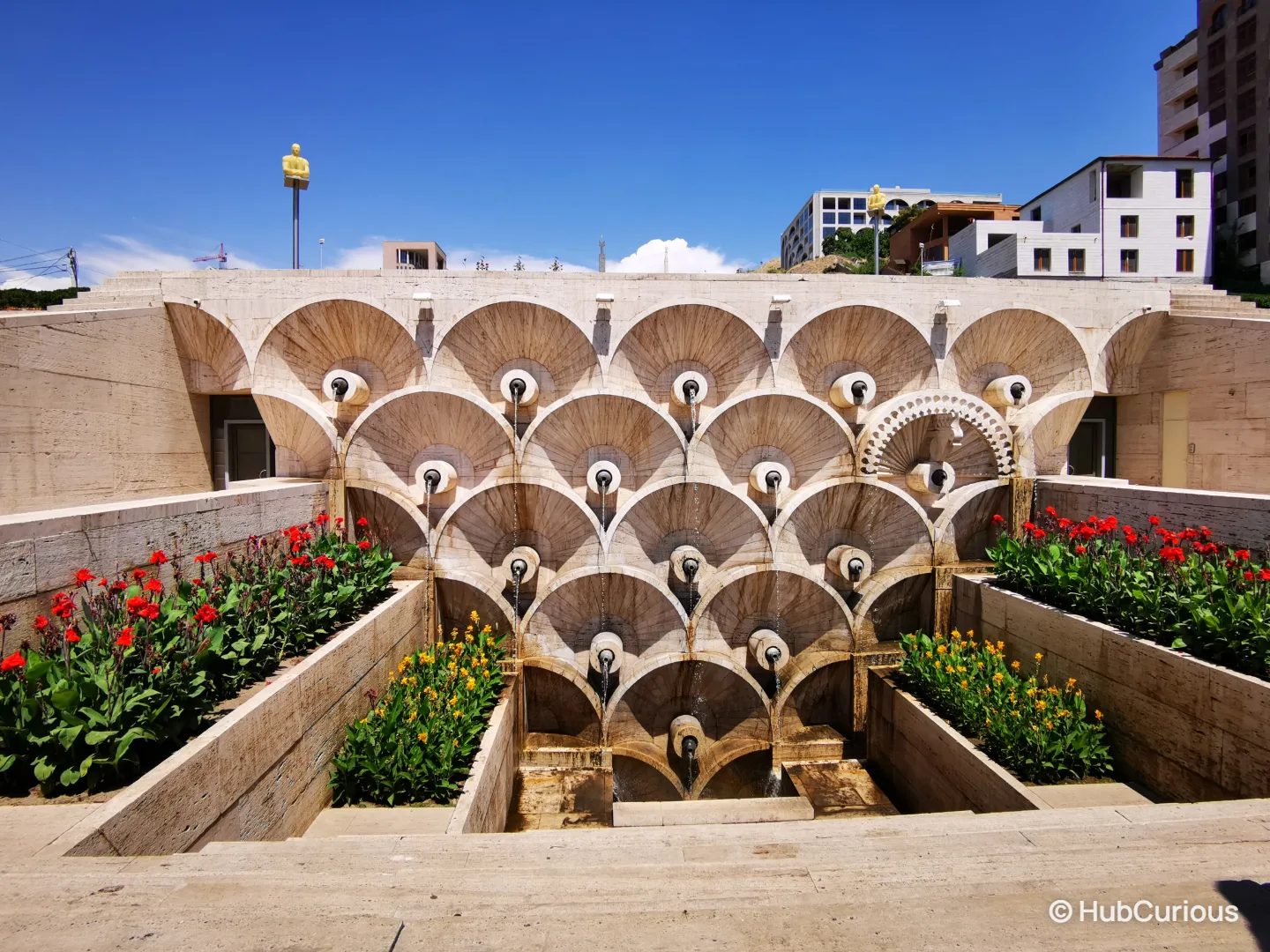
A staircase, a sculpture garden and a museum, all free apart from the galleries. The Cascade is 572 limestone steps rising from the Tamanyan Street gardens to the terrace above the city. The idea came from Alexander Tamanyan's 1920s master plan for Yerevan, but nothing happened for half a century. Construction began in 1971, stalled after the 1988 Spitak earthquake and the collapse of the Soviet Union, and the top section stood unfinished for over a decade. In 2002 the Armenian-American philanthropist Gerard Cafesjian funded the restoration; the Cafesjian Center for the Arts opened inside in November 2009. There is an escalator running up the hillside, free to use, which is the sensible way up in August.
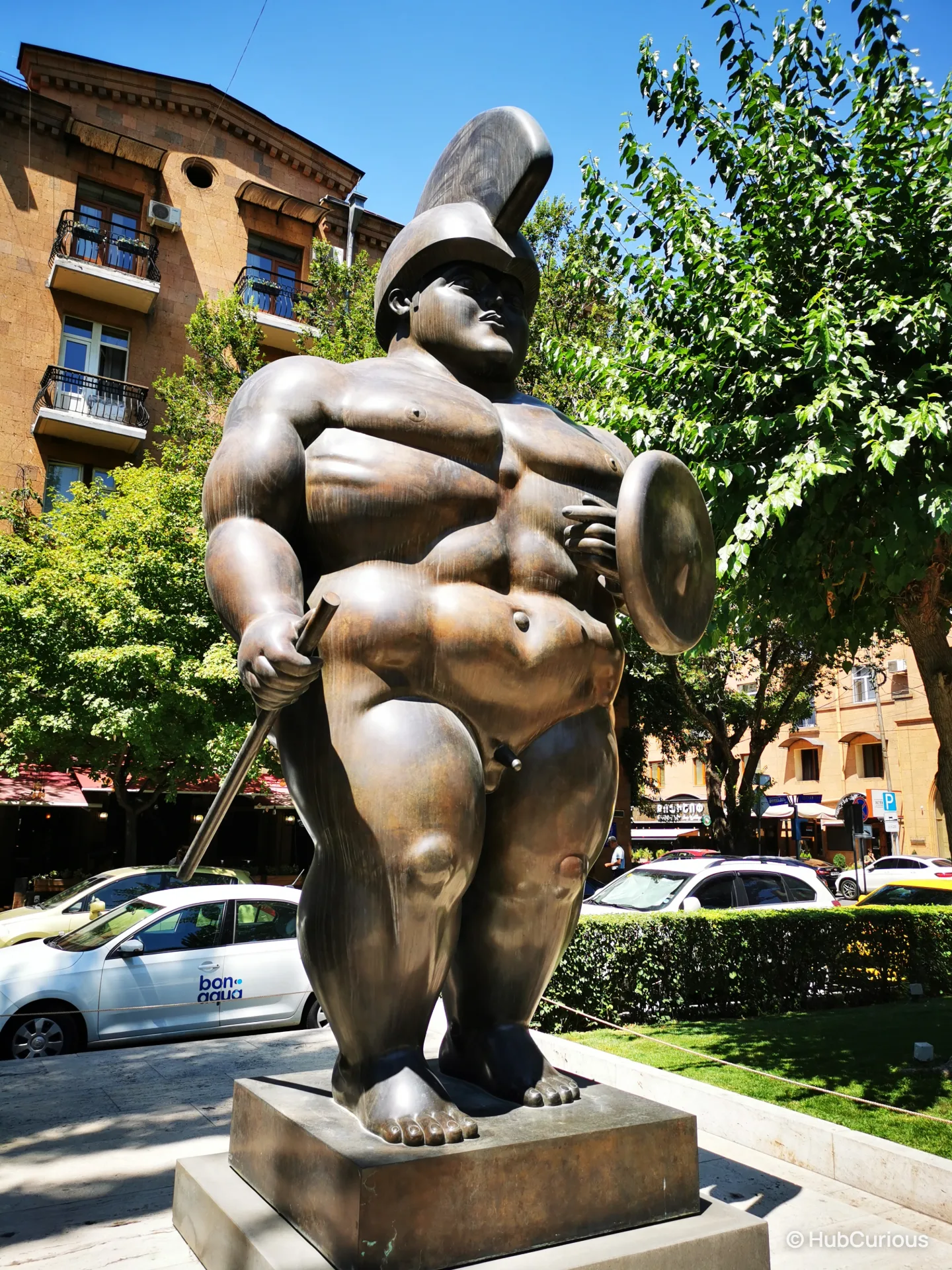
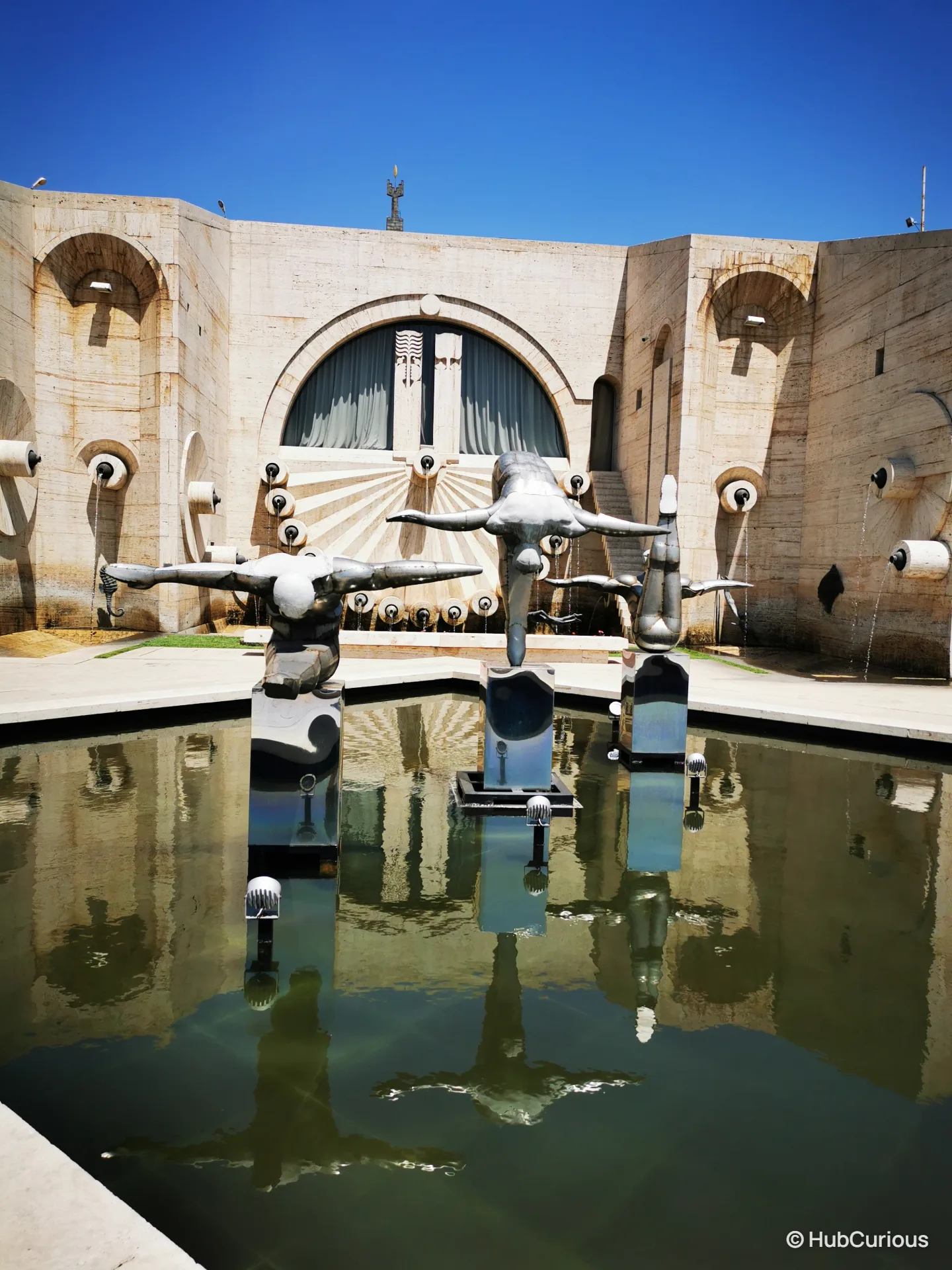
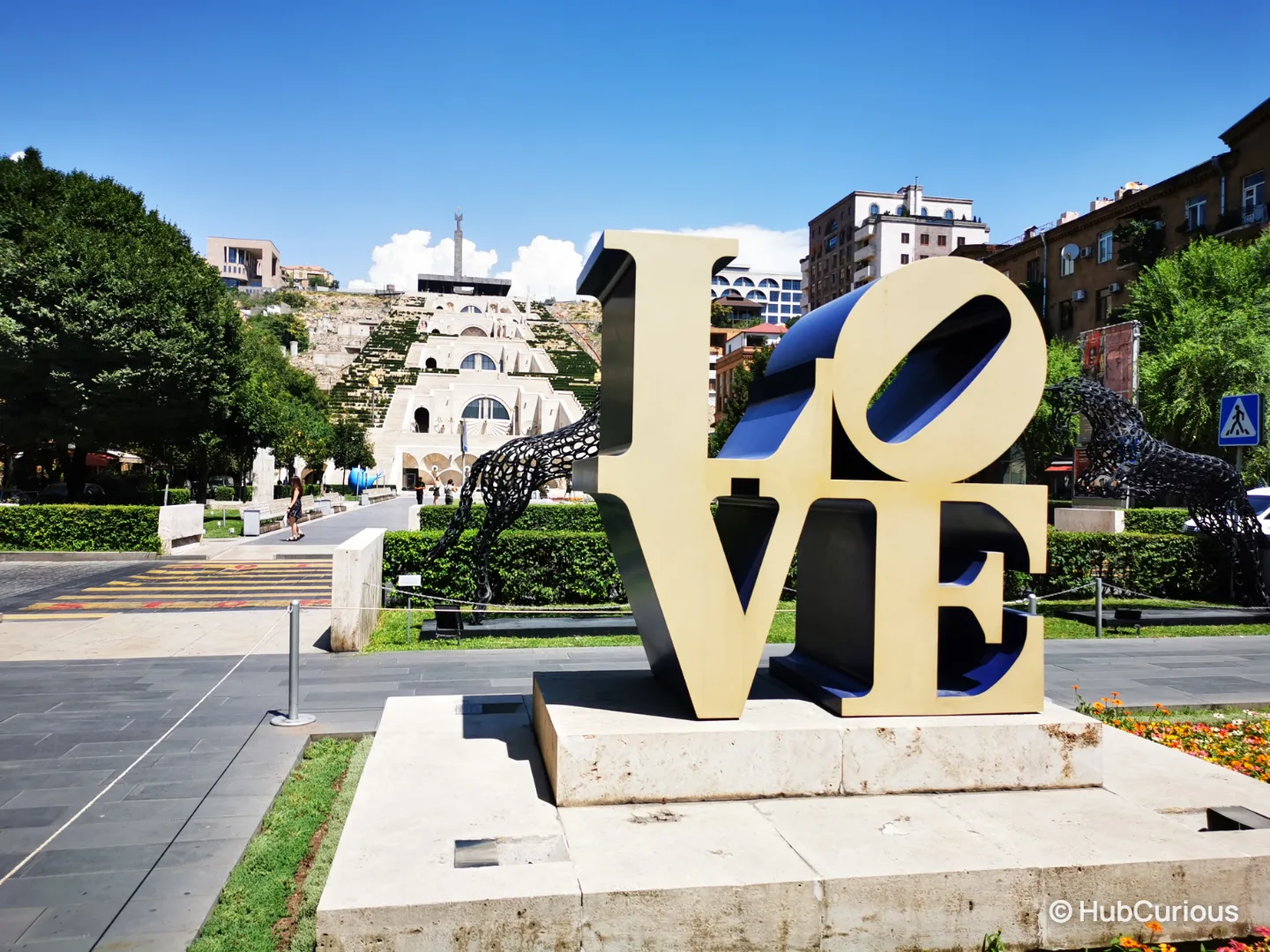
The sculptures are the reason to slow down. Botero's Roman Warrior stands in the garden at the foot — bronze, 1985–86, nude apart from helmet and shield, and the most photographed object in the complex by some distance. On one of the upper terraces there is a group of swimmers, mid-stroke, that most people walk straight past. At the foot, where Tamanyan Street opens out, stands Robert Indiana's LOVE — the tilted O, the gold faces and blue sides taken from the colours of the Indiana state flag. Indiana never secured the copyright on the design, so it went everywhere without him: onto a US postage stamp in 1973, and onto more or less everything since. The original is still worth standing in front of.
What else is worth seeing in central Yerevan?
Two things within walking distance of each other, and they could not be less alike.
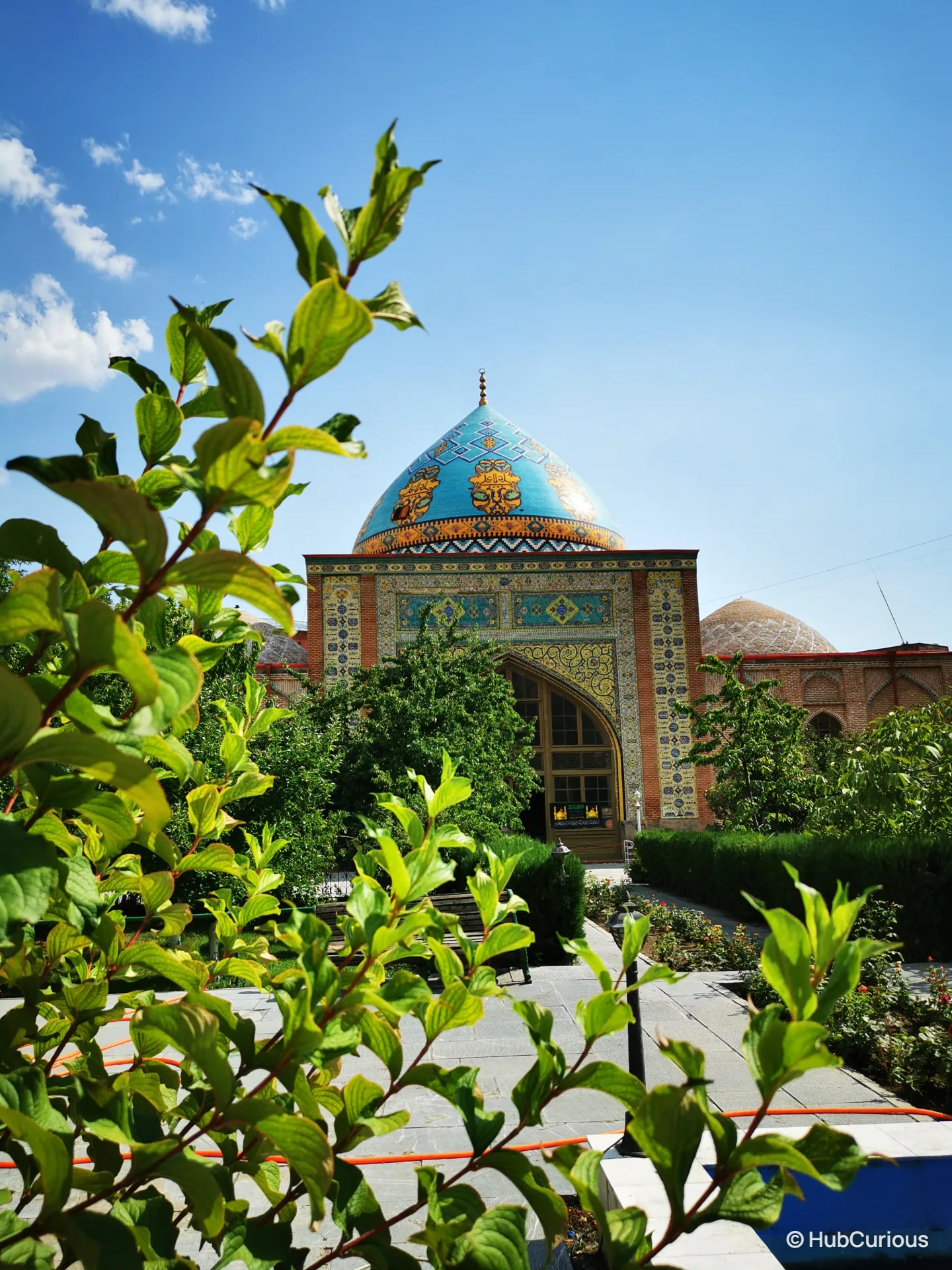
Hoseyn Ali Khan, ruler of the Erivan Khanate, built the Blue Mosque on Mashtots Avenue in 1765–66, and it was the largest of the eight mosques operating in nineteenth-century Yerevan. It is the only one of them still standing, and the only working mosque left anywhere in Armenia. Secularised in the 1920s, it spent more than fifty years as the city history museum, which is probably what saved it. Iranian funding restored it in the 1990s and it returned to use as a mosque. Inside the walls there is a courtyard, a rose garden and a 24-metre minaret, and the noise of Mashtots stops at the gate.
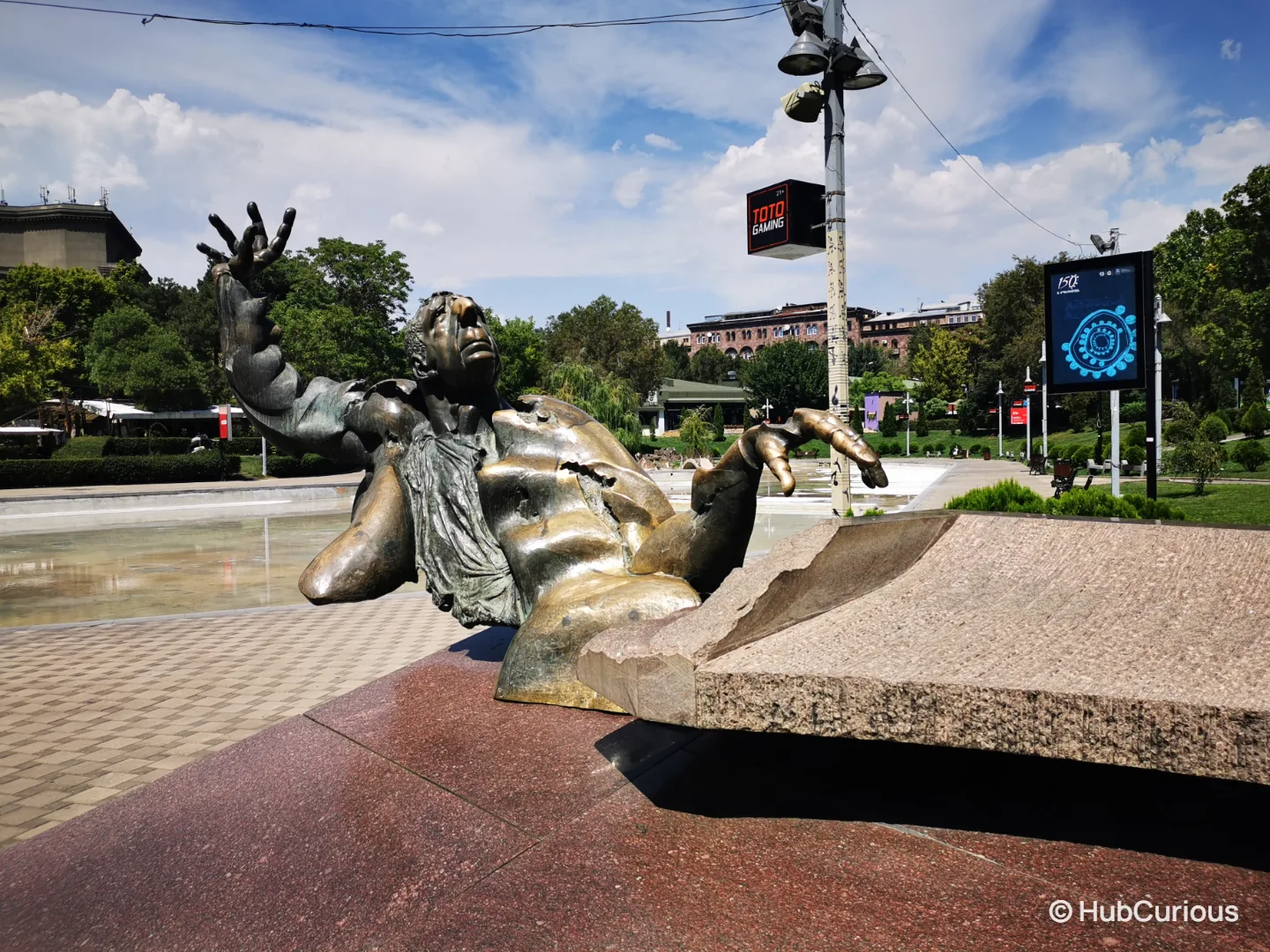
Then the Arno Babajanyan statue by Swan Lake, near the Opera. Babajanyan was one of the most loved Soviet Armenian composers, and the sculptor David Bejanyan showed him at the piano with an expression and a set of fingers that Yerevan found unacceptable. The statue went up in September 2002 and was taken down again before it could be unveiled. Bejanyan shortened the fingers, toned down the face, and seven months later it returned. It was officially unveiled on 4 July 2003 with Babajanyan's "Nocturne" playing. People still argue about it, which seems like the right outcome.
Are Armenians friendly to tourists?
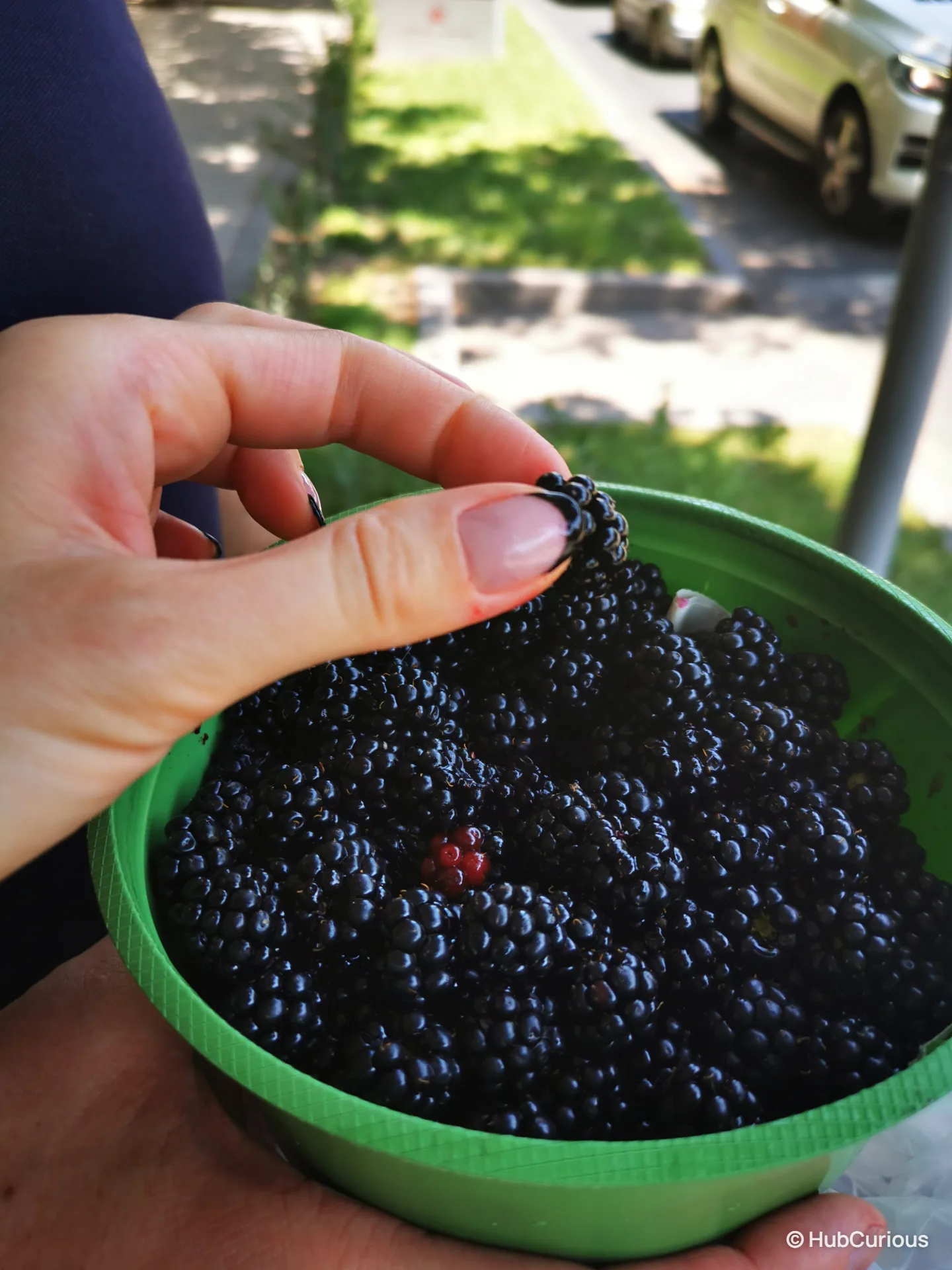
In our experience, consistently and without any of it feeling like sales. The tomatoes were one instance. Another was a bucket of blackberries we bought from an old man on a side street — not at a market, just a man with a bucket in a doorway. Yerevan is full of these small arrangements: someone sitting in a gap between buildings with whatever they have that day. It is worth looking down side streets for that reason alone.
Where should you stay in Yerevan?
We used Booking for both ends of the trip and stayed in two different places.
Bass Boutique Hotel at the start, up near Aygedzor Street, and Kantar Hotel at the end, a few minutes from Republic Square. Both were comfortable, clean, well positioned and did good breakfasts.
The caveat matters, though: this was 2021. Read the current reviews before you book either — our experience is a data point, not a guarantee.
Where to eat and drink in Yerevan
El Garden for dinner: a large garden restaurant out on Tsitsernakaberd Highway, outdoor seating, the kind of place an evening expands into. El Sky Bar on Grigor Lusavorich Street for later — a rooftop with the city laid out underneath it. Both are still trading.
Do you need a car in Yerevan?
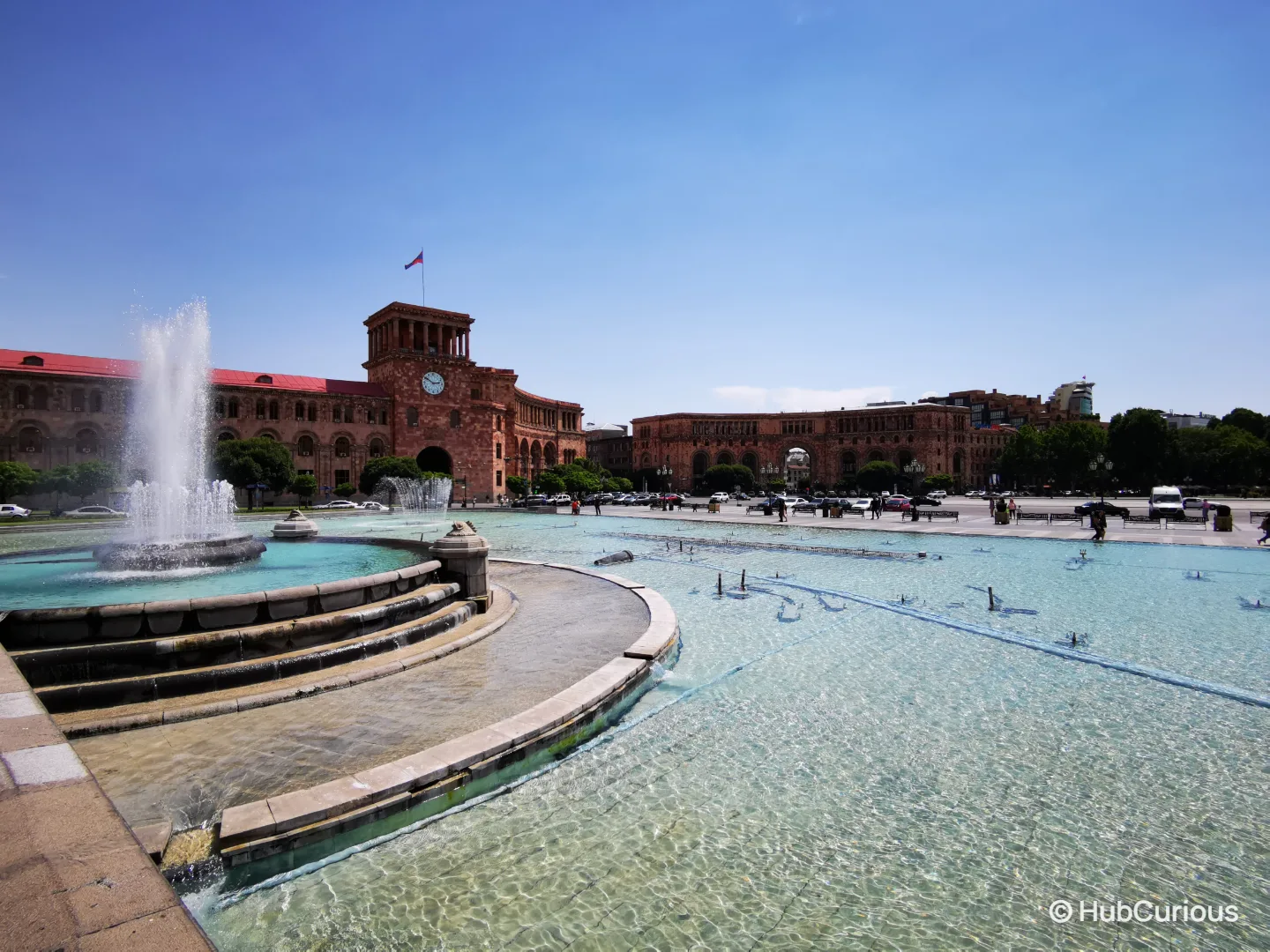
No, and it is easier without one. The centre is walkable and the Cascade, the mosque, Swan Lake and Republic Square sit within a comfortable radius. The car is for the country, not the city.
When walking stops being appealing, neither Uber nor Bolt operates in Armenia. What people actually use is Yandex Go and the local app GG Taxi, and a ride across central Yerevan starts at a few hundred drams. Both register you by SMS, so it is worth installing them at home rather than working it out in the arrivals hall.
We hired ours from Sixt in Yerevan and drove 1,330 kilometres with it. If you would rather not drive at all, day trips to Garni, Geghard and Lake Sevan run from the city and can be booked in advance through GetYourGuide — we did not use them, since we drove ourselves, but they cover most of what is in the road trip post. For a fixed price rather than a meter, Kiwitaxi prebooks transfers from Zvartnots to the centre from around $24, and longer runs out to Dilijan or Tsaghkadzor.
One practical thing that made the first hour easy: we had an Airalo eSIM activated before we took off, so we walked out of Zvartnots with maps already working and never queued at a SIM counter.
Yerevan did not announce itself. It handed us three tomatoes and let us work the rest out.